|
Flock History
As far
as Baglien family historians can tell us, our family has
been raising sheep since the 8th century. We
have, with rare interruptions, been doing so ever
since. In the late 1980s, a Baglien boy married a girl who had grown up
raising commercial Hamps. That
they would someday raise sheep together came, as one
might expect, as no great surprise.
In
2000, we acquired our first registered Suffolks from
Brenda Miller. They were thick, sound sheep of their
type and kind. However, our flock emphasis moved to
moderately-framed Suffolks, as better suited to
producing the heavily-muscled carcasses and convenience
traits that are our primary objectives.
After experimenting with
various bloodlines, including considerable use of LAI,
we decided to base our flock chiefly on Kimm genetics.
We have not regretted this decision. We first used Bobs
genetics in 2002 via LAI, and purchased some ewe lambs
in 2003. In 2004, we acquired two Kimm rams, 4136 and
4208. Kimm 4136 would go on to win two slick-sheared
classes at UJSSA national shows in Laramie and Sedalia,
and sire the high-indexing Suffolk in the 2005 NW
Performance Sire Test, but this fine performance was
overshadowed by that of his cousin, 4208, who became our
lead stud from 2005 to 2008. In the same year (2004), we purchased nine
ewe lambs from Dr. Paul Eness, all of whom were sired by
Kimm 2048 Cael, a heavily-muscled McLaughlin 1-144 son
that is one of the top Suffolks in the NSIP program for
growth. Further acquisitions would follow, but these
sheep gave our program its foundation in producing the
heavily-muscled, fast-growing Suffolks we favor.
In our program, the following
rams figure prominently:
McLaughlin-Griffin 1-144
(reference sire only)
In 2001, Bob Kimm leased this ram lamb from Willard
McLaughlin. He only sired one lamb crop for Bob, but
what a get! To name some of the top studs produced that
year: 2022 (Bobs keeper, used by him for five
seasons), 2027 (McLaughlins keeper, used successfully
by him for several seasons), 2029 The Matrix (as good
or better than 2022), and 2048 Cael (sire of Champion
and Reserve Champion lambs at the National Lamb Show,
and a top ram in NSIP). If you look at the extended
pedigrees of our flock, Mac 1-144 appears one or more
times in that of almost every sheep.
Kimm
2048 Cael (reference sire only)
This ram was one of the heaviest-muscled Mac 1-144 sons
in the 2002 Kimm sale, and was purchased by Dr. Paul
Eness. Dr. Eness has long emphasized muscling and
growth EPDs in his program. Christened Cael after a
top amateur wrestler, this ram quickly rose in the
rankings to become an
NSIP Trait-Leading Sire for both pre-weaning and
post-weaning growth. In addition, he twice sired the
Champion or Reserve Champion carcass lamb at the
National Lamb Show. In 2004, we purchased nine Cael
daughters, and they have produced many good sheep in our
program. Later, we acquired Cael's twin sister, Kimm 2049. She dammed
the impressive Dreadnought grandson, 'Brutus', that figures prominently in
our pedigrees.
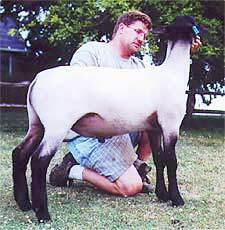
Kimm 4208
Martok
(used for the 2005-2008 lamb crops)
This ram
was undoubtedly the biggest sleeper in Bob Kimms 2004
production sale. One of the largest Kimm 2027 sons (345 lb.
in breeding condition), out of a Slack 1061F-sired
NSIP Distinguished Dam, this thick-made,
square-docked, correct ram sired just like he looked. He
qualified as an
NSIP Trait-Leading Sire for prolificacy on
the strength of his first lamb crop something that rarely
happens (most rams need at least three or four years to
qualify). The following year he further qualifed as a Trait
Leader for maternal milk (a measure of his daughters
ability to feed multiple lambs). The big bonus, however, was
the superior rib eye areas he sired his retained
daughters averaged 3.73 sq. in. REA at 135 lb. Add to
this great udders and teat placement, and it not surprising
that he has made a significant impact on our program. (Yes,
he was christened after one of our childrens favorite
Star Trek characters; a structurally-sound, thick-made,
solid kind of Klingon.)
|
|
| Slack 8222 - as a 2-year old |
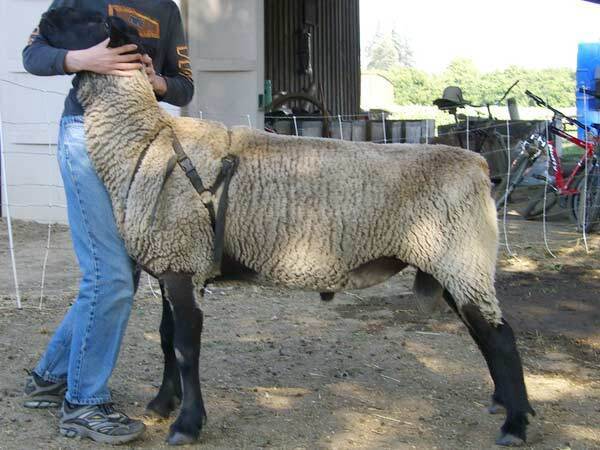
Slack 8222 "Dreadnought" (used for the 2009-2013
lamb crops)
In the spring of 2008 we went to Tom Slack's in Indiana and sorted his entire
ram lamb crop. 8222 and 8300 were our picks. 8222 was one of the
heaviest-muscled rams, and probably the stoutest-boned, of the lot. He proved to
be a prepotent sire, consistently stamping his virtues on lambs from a wide
variety of ewes, and becoming the most influential sire our program has yet
used. Clean-fleeced, very square on his corners and extremely wide and thick in
his hindquarters, he maintained extension through his neck and front end. While
producing excellent daughters, he was exceptional in his male lines, producing
sons, grandsons, and great-grandsons that exhibited his strengths.
|

|
| Slack 8300 - as a yearling |
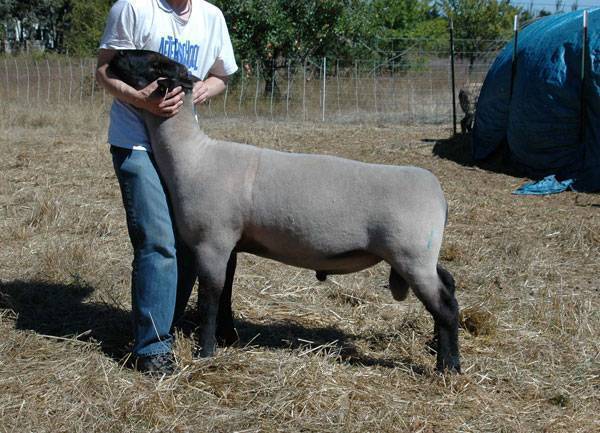
Slack 8300 (used
for the 2009-2013 lamb crops)
8300 was an extremely well-balanced ram, combining thickness, structure, and
profile. Very neat and clean through his chest floor and deep in the rear
flank, he was square in his rack and thick through the leg and stifle. He was
the perfect complement to Dreadnought, producing consistently superior females
as Dreadnought produced superior males.
|
|
Slack 4202
(used for the 2015-2022 lamb crops)
We acquired Slack 4202 for his outstanding hindquarters -
tremendous length was a bonus. He is a well-balanced ram, combining
thickness, structure, and profile. Neat and clean through the chest floor
while deep in his rear flank, he is square in his rack and massive through
the leg and stifle. 4202 sires on these characteristics in his
lambs
|
|
Kimm 14015
(used for the 2018-2022 lamb crops)
We were very pleased to acquire 14015 from Bob Kimm late in
the season, as part of Bob's flock reduction. 14015 was easily our favorite
in the Kimm stud battery, and Bob retains both a son and a maternal brother.
This sire offers great top thickness (REA at 135# just under 4 sq. inches),
superior growth (106# at 60 days of age), clean lines, and
correctness
|
| |
|
  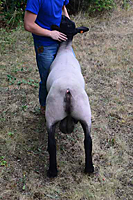 |
Baglien 16760 (used for the 2017-2023 lamb crops)
Click Here To
View Extended Pedigree
We believe Baglien 16760, 'Bull', to be among the thickest,
heaviest-boned, and most structurally correct Suffolk rams in the U.S.
today. Of exclusively American breeding, he is a linebred descendant of our
great long-time stud, Slack 8222 'Dreadnought.' Bull represents the fullest
expression yet of our objectives in producing heavily-muscled,
commercially-valuable Suffolk sheep. He has fully justified our
expectations, predictably passing on his traits to his offspring (semen
available). |
|
|